Better together
Nutrients work as a team
What you eat ≠ what you absorb
Bioavailability — the share of a nutrient your body actually absorbs and uses — depends on:
- Partners that boost it
- Blockers that compete or bind
- How food is cooked & processed
- Your gut health, age & medicines
Sources: Krause's 16th ed.; Hurrell R & Egli I, Am J Clin Nutr 2010; Uwitonze AM & Razzaque MS, J Am Osteopath Assoc 2018
Power couple #1
Iron + vitamin C: squeeze the lemon!
Vitamin C converts plant iron into a form the gut can absorb and keeps it soluble. Adding vitamin C-rich food to a meal can raise non-heme iron absorption 2–3 times.
Palak dal + a squeeze of lemon
Iron: moong/toor dal + spinach
Vit C: fresh lemon, added after cooking
Lemon poha with peanuts & peas
Iron: poha, peanuts
Vit C: lemon, green peas, coriander
Rajma or chole + kachumber
Iron: kidney beans / chickpeas
Vit C: tomato, onion, lemon, raw mango
Sprouted moong chaat
Iron: sprouts (sprouting also cuts phytates)
Vit C: tomato, lemon, raw mango
Bajra or ragi roti + amla chutney
Iron: millets
Vit C: amla — or a guava after the meal
Til-gur laddoo or dates + an orange
Iron: sesame, jaggery, dates
Vit C: orange or guava — not chai!
Sources: Hallberg L et al., Am J Clin Nutr 1989; Lynch SR & Cook JD, Ann NY Acad Sci 1980; ICMR-NIN DGI 2024
Power couple #2
Vitamins A, D, E & K + a little healthy fat
Why the fat?
These vitamins (and carotenoids) hitch a ride into the body inside tiny fat 'bubbles' called micelles. No fat → much of it passes straight through.
3–5 gof fat in a meal — about 1 tsp — is enough to markedly boost carotenoid absorption
Carrot juice + 1 tsp ground flaxseed
Beta-carotene + omega-3 fat. Use ground flax or soaked chia — whole seeds pass undigested.
Sarson saag or palak with 1 tsp ghee
Vitamins A & K from greens, absorbed better thanks to the tadka. Grandma was right!
Salad + peanuts, til or an egg
Oil dressing, roasted seeds or an egg lift carotenoid & vitamin E uptake (Kim et al., 2015).
Pumpkin or sweet potato roasted in oil
Orange veggies are beta-carotene treasure chests — cooking with a little fat unlocks more.
Mango or papaya + a few almonds
Vitamin A from the fruit, vitamin E & fat from the nuts — a perfect evening snack.
Vitamin D3 with your biggest meal
Taken with the largest, fat-containing meal, D3 raised blood levels ~50% (Mulligan & Licata, 2010).
Sources: Brown MJ et al., AJCN 2004; Kim JE et al., AJCN 2015; Mulligan GB & Licata A, J Bone Miner Res 2010; Jayarajan P et al., IJMR 1980
More power couples
Partners that help each other work
Calcium + vitamin D (+ K2)
Vitamin D lets the gut absorb calcium; K2 helps steer it into bones rather than arteries.
Try: ragi malt with milk after a 20-min sunny walk; curd with til chutney
Vitamin D + magnesium
Magnesium is needed to activate vitamin D — when Mg is low, D supplements work less well.
Try: D3 with a meal of dal, greens & a handful of pumpkin seeds
Iron, zinc & calcium + soak, sprout, ferment
Phytates in grains & pulses lock up minerals; soaking, sprouting & fermenting break them down.
Try: idli, dosa, dhokla, sprouted moong, overnight-soaked chana, ragi ambli
Folate + vitamin B12
They work as a pair to build healthy red blood cells & DNA; low B12 'traps' folate in an unusable form.
Try: palak paneer, methi thepla with curd, egg bhurji with spinach
Sources: Holick MF, NEJM 2007; Uwitonze AM & Razzaque MS, 2018; Gibson RS et al., Food Nutr Bull 2010; Shoba G et al., Planta Med 1998
Absorption blockers
The 'frenemies' on your plate
Chai or coffee with meals
Tea tannins can cut the absorption of plant iron by up to 60–90%.
Fix: have tea/coffee at least 1 hour before or after meals
Calcium vs iron
They compete for absorption when taken together.
Fix: space calcium & iron tablets 2+ hours apart
Phytates
Found in bran, whole grains & pulses — they bind iron, zinc and calcium.
Fix: soak, sprout, ferment & cook grains and dals
Oxalates
Spinach calcium is only ~5% absorbed vs ~30% from milk.
Fix: count on dairy, ragi & til for calcium — not spinach
Some medicines
Antacids/PPIs lower B12, iron & Mg; metformin lowers B12; calcium & iron block thyroid tablets.
Fix: take thyroxine alone, 4 h from calcium/iron
Alcohol & smoking
Alcohol drains B1, folate, zinc & Mg; smokers need 35 mg more vitamin C a day.
Fix: limit alcohol; extra vitamin C foods if you smoke
Sources: Hurrell RF et al., Br J Nutr 1999; Weaver CM et al., AJCN 1999; ICMR-NIN DGI 2024; IOM DRIs for vitamin C (smokers +35 mg/day)
Supplementation
Food first — but not always food only
The ground rules
- Supplements fill gaps — they can't fix a poor diet
- Test, don't guess — check levels first
- More is not better — fat-soluble vitamins & minerals can build up to toxic levels
- Tell your doctor about every supplement you take
Useful tests
CBC, serum ferritin, vitamin B12, 25(OH) vitamin D, TSH — others as advised
Who may genuinely need one?
Pregnancy & planning it
Folic acid before conception; iron-folic acid, calcium & iodine in pregnancy (as per antenatal protocols)
Vegetarians & vegans
Vitamin B12 almost always; check iron, vitamin D and omega-3 (algal DHA)
Adults over 50
B12 (less stomach acid), vitamin D and calcium for bone health
Little sun exposure
Vitamin D3 — dose guided by a blood test
Heavy periods or anaemia
Iron (with vitamin C), after confirming low Hb / ferritin
Medical conditions & medicines
Metformin, PPIs, IBD / celiac, bariatric surgery, kidney disease — need tailored plans
Sources: Anemia Mukt Bharat operational guidelines, MoHFW 2018; ICMR-NIN 2020; Krause's 16th ed.
Supplementation
Using supplements smartly: form, timing, safety
| Nutrient | Smarter form | When to take | Watch out for |
|---|---|---|---|
| Vitamin D | D3 (cholecalciferol) raises blood levels better than D2 | With your largest, fat-containing meal | Adult upper limit 4,000 IU/day unless prescribed; excess → high calcium, kidney stones |
| Iron | Ferrous salts or bisglycinate (gentler); alternate-day dosing may absorb better | Empty stomach with lemon/orange; a small snack if it causes nausea | Not with tea, milk, calcium or antacids; dark stools are normal; keep away from children |
| Calcium | Carbonate (take with food) or citrate (any time; better with low stomach acid) | ≤ 500 mg elemental per dose; split larger doses | 4 h away from thyroid tablets; excess → constipation, kidney stones |
| Vitamin B12 | Methylcobalamin or cyanocobalamin; injections if absorption is poor | Morning, with or without food | Very safe; check B12 before taking high-dose folic acid |
| Magnesium | Glycinate or citrate (gentle); oxide acts more as a laxative | Evening — may help sleep & cramps | Avoid or adjust in kidney disease; loose stools = too much |
| Vitamin A | Mostly as beta-carotene from food | With a meal that has some fat | Preformed vitamin A above 3,000 µg/day is harmful; avoid high doses in pregnancy |
Sources: IOM DRIs 2011 (vitamin D, vitamin A ULs); Stoffel NU et al., Lancet Haematol 2017; Tripkovic L et al., AJCN 2012; NIH ODS fact sheets
Putting it together
A micronutrient-smart day
Breakfast
Veg poha with peanuts + lemon, or eggs + whole-wheat toast + an orange
1 hour later
Your chai or coffee — away from the iron-rich meal
Mid-morning
15–20 min of sun on arms & legs + a guava or amla
Lunch
Rajma-rice + kachumber with lemon + a bowl of curd
Evening
Carrot-beet juice + 1 tsp ground flaxseed, or roasted chana + nuts
Dinner
Palak paneer in 1 tsp ghee + bajra/ragi roti (D3 here, if prescribed)
Next up: gut health →
5 things to remember
Eat a rainbow — variety covers most needs
Pair smart: iron + vitamin C; A, D, E, K + a little fat
Keep blockers apart: tea, calcium & iron
Cook to conserve: less water, less heat, lemon last
Test, don't guess — supplement with expert guidance
Bonus · Antioxidants
Antioxidants: your body's rust-proofing
The cut-apple test
Slice an apple and it turns brown within minutes. That's oxidation — the same family of reactions that rusts iron.
Squeeze lemon on it and it stays fresh. Lemon's vitamin C is an antioxidant: it takes the hit so the apple doesn't.
Inside our cells, the 'sparks' are called free radicals — unstable molecules that can damage fats, proteins and DNA.
Try it: cut an apple in two, add lemon to one half — compare after 20 minutes.
Sources of free radicals
Simply living
breathing, digesting, exercising — normal and needed
Smoking
including second-hand smoke
Air pollution
traffic, smog, chulha smoke
Too much sun
UV rays on unprotected skin
Heavy alcohol
loads the liver with oxidants
Reused frying oil
repeatedly heated oil forms harmful by-products
Two lines of defence
1 Your built-in fire brigade
The body makes its own antioxidant enzymes — they need zinc, copper, manganese & selenium from food.
2 Help from your plate
Vitamins C & E, carotenoids (beta-carotene, lycopene, lutein) and polyphenols in fruit, veg, dals, nuts, tea, coffee & spices.
Not all free radicals are bad. Immune cells use them to kill germs. Trouble starts with an imbalance — oxidative stress.
Sources: Halliwell B & Gutteridge JMC, Free Radicals in Biology and Medicine, 5th ed.; Sies H, Redox Biol 2015; Krause's 16th ed.; FSSAI used-cooking-oil norms
Bonus · Antioxidants on your plate
Eat the rainbow — each colour, a different shield
Red
LycopeneTomato, watermelon, red capsicum, guava (pink)
Cook tomatoes with a little oil — more lycopene is absorbed than from raw.
Orange & yellow
Beta-caroteneCarrot, pumpkin, papaya, mango, sweet potato
Body makes vitamin A from it only as needed — safe from food.
Green
Lutein, vitamin C, folatePalak, methi, drumstick leaves, broccoli, peas
Lutein collects in the eye's retina and helps filter harsh blue light.
Purple & blue
AnthocyaninsJamun, black grapes, purple cabbage, brinjal, black rice
The colour sits in the skin — don't peel it away.
White & brown
Polyphenols, vitamin EGarlic, onion, nuts, seeds, whole grains, dals, tea, coffee, spices
A small handful of nuts/seeds a day covers much of your vitamin E.
Vitamin C stars
Vitamin CAmla, guava, lemon, orange, capsicum, kachumber
Heat & air destroy it — have something raw every day.
How much?
400 g + 100 gvegetables (incl. greens) + fruit a day — ICMR-NIN 'My Plate for the Day'
risk of early death in people eating ~800 g fruit & veg a day vs very little (95 studies)
Easy rule: 2+ colours on every plate, 5+ colours across the day. Variety beats any single 'superfood'.
Sources: ICMR-NIN 'My Plate for the Day', DGI 2024; WHO healthy diet fact sheet; Aune D et al., Int J Epidemiol 2017; AREDS2 Research Group, JAMA 2013; Unlu NZ et al., J Nutr 2005
Bonus · Food vs pills
Antioxidants work best on a plate, not in a pill
As high-dose pills
Beta-carotene pills raised lung cancer in smokers by 18% (ATBC) and 28% (CARET)
Vitamin E pills (400 IU/day) raised prostate cancer by 17% (SELECT)
78 trials, ~297,000 people: no longer life; beta-carotene & vitamin E slightly raised deaths (Cochrane)
Mega-dose C + E blunted the health gains from exercise (small trial)
As real food
~30% fewer heart attacks & strokes with a Mediterranean-style diet rich in nuts & olive oil (PREDIMED)
~1/3 lower risk of early death with plenty of fruit & vegetables (95 studies)
Why the difference? Food brings fibre, potassium & hundreds of compounds together, in safe doses
One exception: a specific eye formula for macular degeneration — only on a doctor's advice
Myth-busters
'ORAC score' on the label? A test-tube number — the US government withdrew its ORAC database in 2012.
'Detox' & 'antioxidant water'? Your liver and kidneys do the detox. No drink does it for them.
'Superfood' powders? No single food beats variety — and powders often lose the fibre.
Start tomorrow
2+ colours on every plate
A small handful of nuts or seeds daily
Cook tomatoes & greens with a little oil
Something raw & vitamin C-rich every day
Move daily, don't smoke — your body's own defences grow stronger
Supplements only if a test or doctor says so
Sources: ATBC, NEJM 1994; CARET, NEJM 1996; SELECT, JAMA 2011; Bjelakovic, Cochrane 2012; Ristow, PNAS 2009; PREDIMED, NEJM 2018; Aune, IJE 2017; USDA 2012
Gut health · The basics
Your gut: much more than a food pipe
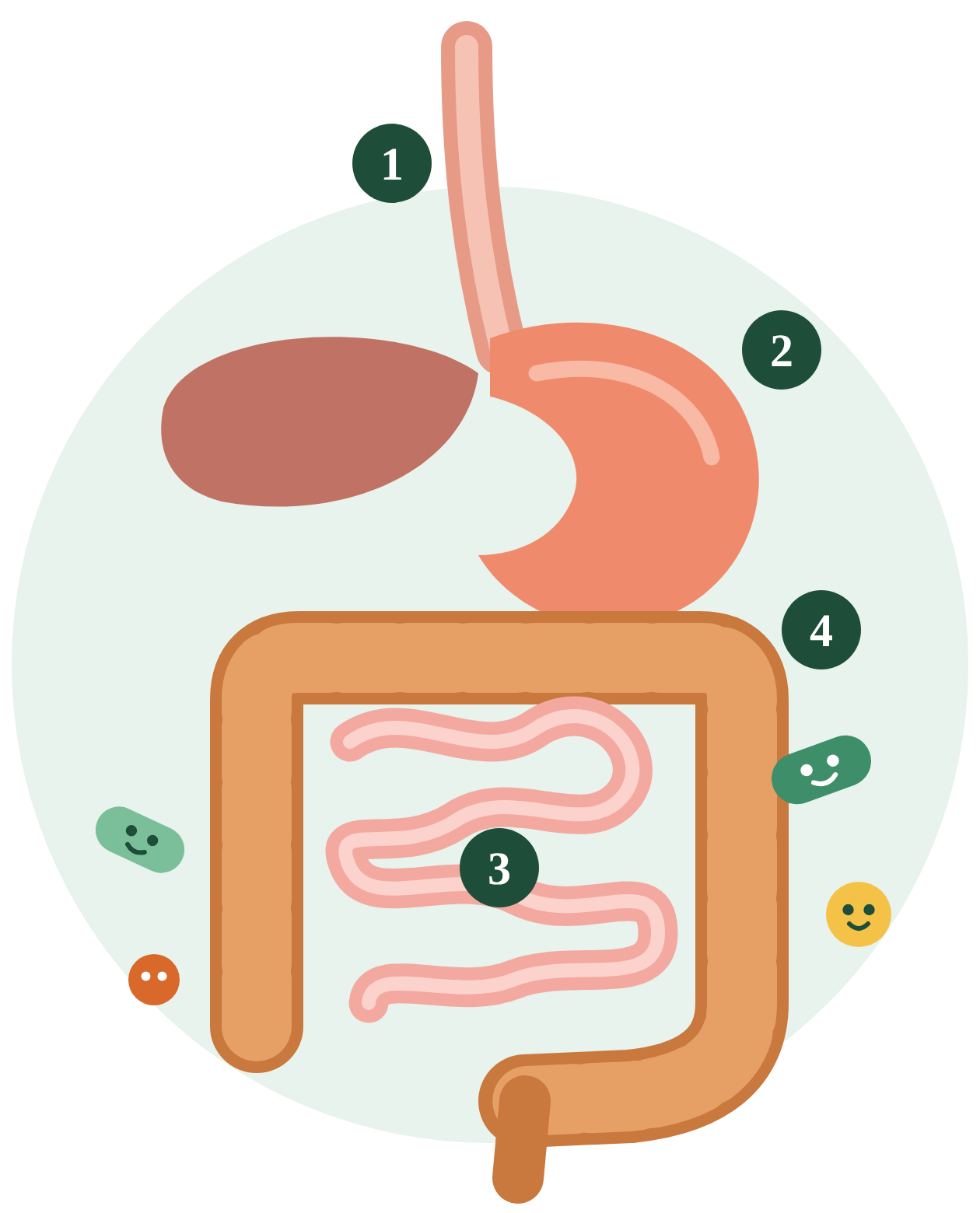
Mouth & food pipe
Digestion starts here. Chew well and eat slowly.
Stomach
Acid & enzymes break food down and kill many germs.
Small intestine
About 6 metres long and absorbs most of your nutrients.
Large intestine
Home to trillions of friendly bacteria; absorbs water and forms stool.
Why your gut matters
of your immune cells live in the gut wall
of bacteria: about as many as your own body cells
are wired together. That is why stress brings "butterflies" or loose motions
Sources: Vighi G et al., Clin Exp Immunol 2008; Sender R et al., PLoS Biol 2016; Mayer EA, Nat Rev Neurosci 2011; Connell AM et al., BMJ 1965
Gut health · Everyday habits
8 daily habits your gut will thank you for
Eat on a rhythm
Regular meal times; avoid skipping meals and late, heavy dinners.
Slow down & chew
15–20 minutes a meal, phone away. Less gas, better digestion.
Fibre at every meal
Whole grains, dals, veggies, fruit with peel. Aim for 25–30 g a day; build up slowly.
Drink enough water
8–10 glasses a day, more in summer. Fibre needs water to work.
Go for variety
Mix grains, dals, veg, fruit, nuts & seeds. A fun target: 30 plant foods a week.
Move every day
30 minutes of activity, plus a 10-minute walk after meals.
Sleep & de-stress
7–8 hours of sleep; 5 minutes of slow breathing. Stress upsets the gut.
Go easy on these
Fried & ultra-processed foods, sugary drinks, alcohol, smoking. Antibiotics only when prescribed.
Sources: WHO carbohydrate intake guideline 2023 (≥25 g fibre/day); ICMR-NIN Dietary Guidelines for Indians 2024; McDonald D et al., mSystems 2018; Buffey AJ et al., Sports Med 2022
Common problem #1 · Constipation
Constipation: get things moving again
Is it constipation?
- ✓Fewer than 3 stools a week
- ✓Hard, lumpy stools
- ✓Straining or pain
- ✓Feeling "not fully empty"
Common causes
Low fibre & water, sitting all day, ignoring the urge, travel, some medicines (iron, calcium, antacids), low thyroid.
Eat to keep things moving
2 green kiwis a day
or a handful of prunes; both work in trials
Fruit with peel
guava, pear, papaya, orange: eat, don't juice
Whole grains & dals
millets, whole wheat, sabzi & salad every meal
Isabgol (psyllium)
1–2 tsp in a full glass of water, start low
Water with fibre
8–10 glasses, or fibre can make it worse
Daily habits
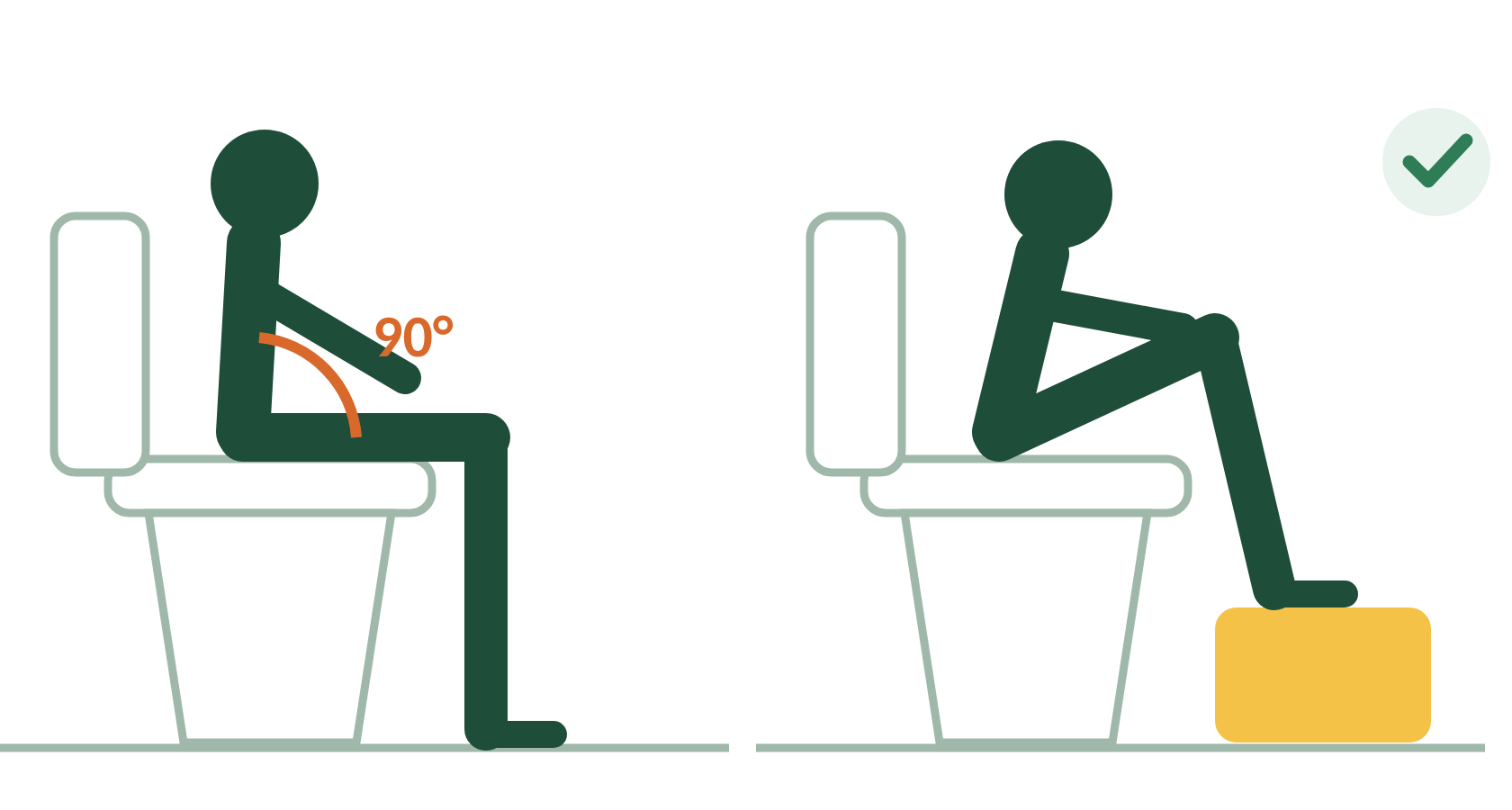
Knees above hips: a small footstool may make it easier.
- Same toilet time daily; after breakfast is ideal
- Never ignore the urge
- Walk or move every day
Sources: Chey SW et al., Am J Gastroenterol 2021; ACG/AGA chronic idiopathic constipation guideline 2023; Modica R et al., J Clin Gastroenterol 2019
Common problem #2 · Acidity & reflux (GERD)
Acidity & reflux: keep the acid where it belongs
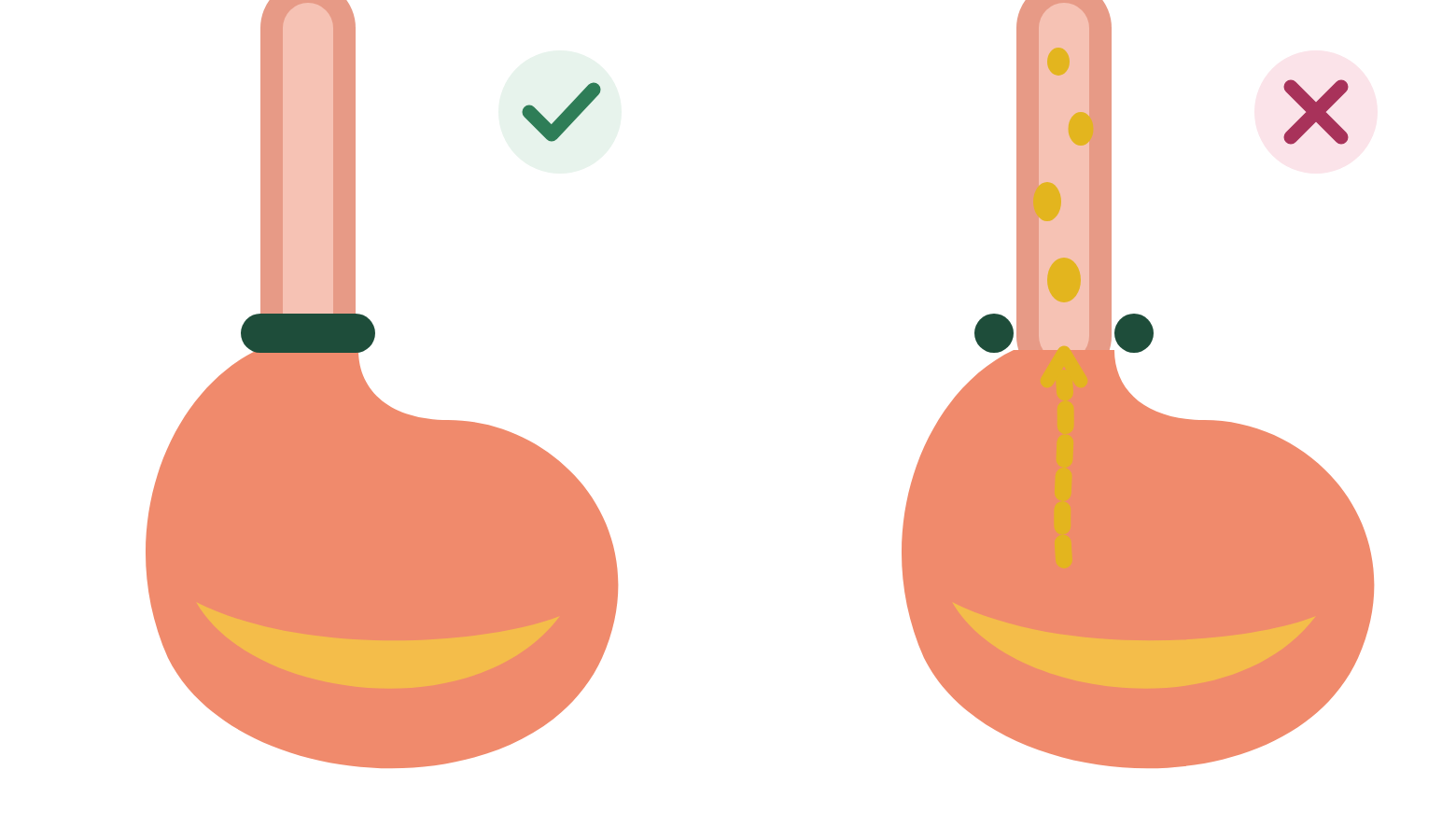
Valve shut:
acid stays down
Valve loose:
acid splashes up
Feels like: burning in the chest, sour burps, a bitter taste, or a cough or hoarse voice at night.
On your plate
Smaller meals
stop when about 80% full
Early dinner
2–3 hours before bedtime
Know your triggers
fried food, chocolate, mint, fizzy drinks, alcohol, too much tea/coffee
Walk, don't lie down
a gentle stroll after meals
In your routine
Lose extra weight
the single most helpful step
Raise the bed head
6–8 inch blocks; extra pillows don't work
Sleep on your left side
less acid at night
Quit smoking
and wear loose waistbands
Sources: Katz PO et al., ACG GERD guideline, Am J Gastroenterol 2022; Ness-Jensen E et al., Clin Gastroenterol Hepatol 2016; Schuitenmaker JM et al., Am J Gastroenterol 2022
Common problem #3 · Bloating & gas
Bloating: let the air out of the balloon
Why it happens
Swallowed air
eating fast, straws, gum, fizzy drinks
Gassy foods
rajma, chana, onion: healthy, but they ferment
Milk sugar
lactose intolerance is common in adults
Constipation
trapped stool traps gas too
Too much, too fast
sudden fibre jumps, sugar-free sweets
Stress & hormones
tense days, the week before periods
What helps
- ✓Eat slowly with your mouth closed; skip straws, gum & fizzy drinks
- ✓Soak dals & beans overnight, drain, then pressure-cook. Start small; moong dal is the gentlest
- ✓Add fibre gradually, with more water
- ✓If milk bothers you, try curd, chaas or lactose-free milk
- ✓Take a 10–15 minute walk after meals
- ✓Keep a 2-week food & symptom diary to spot your own triggers
Sources: Lacy BE et al., Am J Gastroenterol 2021; Misselwitz B et al., Gut 2019; NICE NG12 suspected cancer 2015; Monash University FODMAP research
Prebiotics & probiotics · 1
Probiotics & prebiotics: think of a garden
Prebiotics
The fertiliser
Fibres you can't digest, but your good bacteria love to eat.
e.g. onion, garlic, raw banana, oats, dals
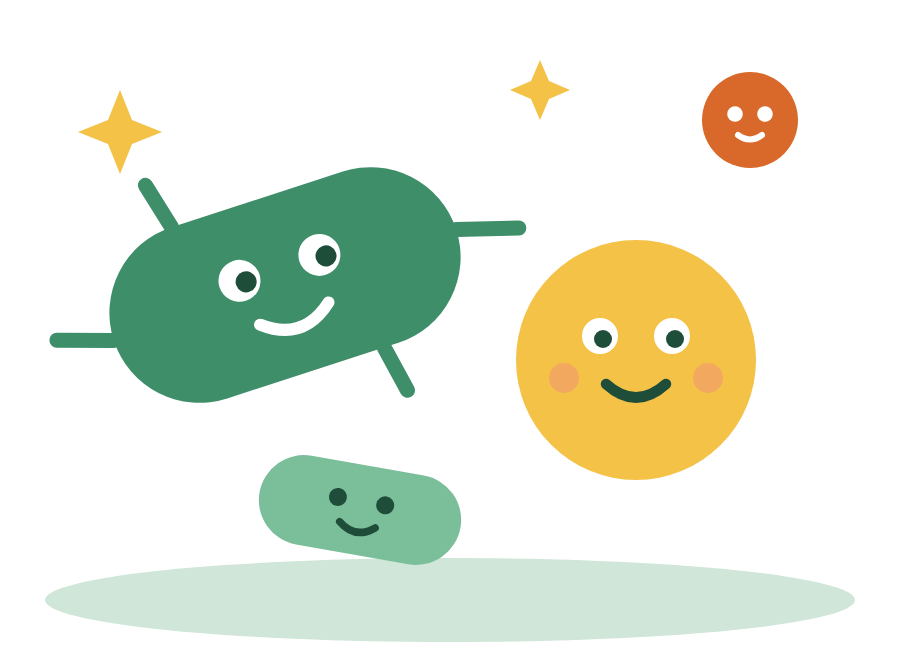
Probiotics
The good plants
Live, friendly bacteria in some foods (and supplements) that join your gut garden.
e.g. curd, chaas, kanji
The harvest
Good stuff for you
Bacteria turn fibre into short-chain fatty acids (like butyrate): fuel for your gut lining, a stronger gut wall, calmer inflammation.
Synbiotic = both together good bacteria + their food
Curd + banana
Curd rice with cooled rice
Overnight oats in curd
Myth-check: fermented ≠ always probiotic
Steaming and cooking kill most bacteria in idli, dosa, dhokla & bread — still great, easy-to-digest foods. Most achaar is oil & salt, not a probiotic.
Sources: ISAPP consensus statements: Hill C et al. 2014 (probiotics), Gibson GR et al. 2017 (prebiotics), Marco ML et al. 2021 (fermented foods); Koh A et al., Cell 2016
Prebiotics & probiotics · 2
Feed your good bacteria: Indian prebiotic foods
Onion & garlic
Try: kachumber, raita with raw onion, tadka
Raw or just-ripe banana
Try: kachche kele ki sabzi or tikki
Oats & barley (jau)
Try: oats upma, jau dalia, sattu drink
Millets & whole wheat
Try: ragi dosa, bajra roti, jowar bhakri
Dals & beans
Try: rajma, chana, lobia, moong sprouts
Cooked & cooled rice
Try: curd rice or lemon rice from leftover rice; aloo chaat
Apple & pear with peel
Try: eat the whole fruit, not the juice
Flax, nuts & seeds
Try: 1 tbsp ground flaxseed in atta or curd
Sources: Gibson GR et al., ISAPP 2017; Sonia S et al., Asia Pac J Clin Nutr 2015 (cooled rice, resistant starch); Slavin J, Nutrients 2013; ICMR-NIN Dietary Guidelines for Indians 2024
Prebiotics & probiotics · 3
Add good bacteria: everyday probiotic foods
Homemade dahi / curd
A katori a day, set fresh at home
Chaas / buttermilk
With jeera & pudina after lunch
Kanji
Fermented carrot-beetroot drink
Fermented rice
Pazhaya sadam, panta bhat, pakhala, made hygienically
Probiotic yoghurt & kefir
Look for "live & active cultures" on the label
Brine pickles & kimchi
Salt-water fermented (not oil achaar); salty, so small portions
Probiotic supplements?
- ✓Not needed by everyone: food first
- ✓Benefits depend on the exact strain, not the "billions"
- ✓Can help in specific cases, e.g. diarrhoea with antibiotics. Ask your doctor or nutritionist
- ✓Avoid if very ill or with weak immunity
The everyday gut rule
1 probiotic + 1 prebiotic food every day
e.g. curd with onion kachumber at lunch; chaas with sprouts chaat in the evening.
Thank you!
Questions?
Sources: Hill C et al., ISAPP 2014; Marco ML et al., ISAPP 2021; Guo Q et al., Cochrane 2019 (probiotics for antibiotic-associated diarrhoea); AGA Clinical Practice Guidelines on probiotics 2020