01 / 16
NEEYAFIT

NeeyaFit  ·  Nutrition webinar

Meet your coach
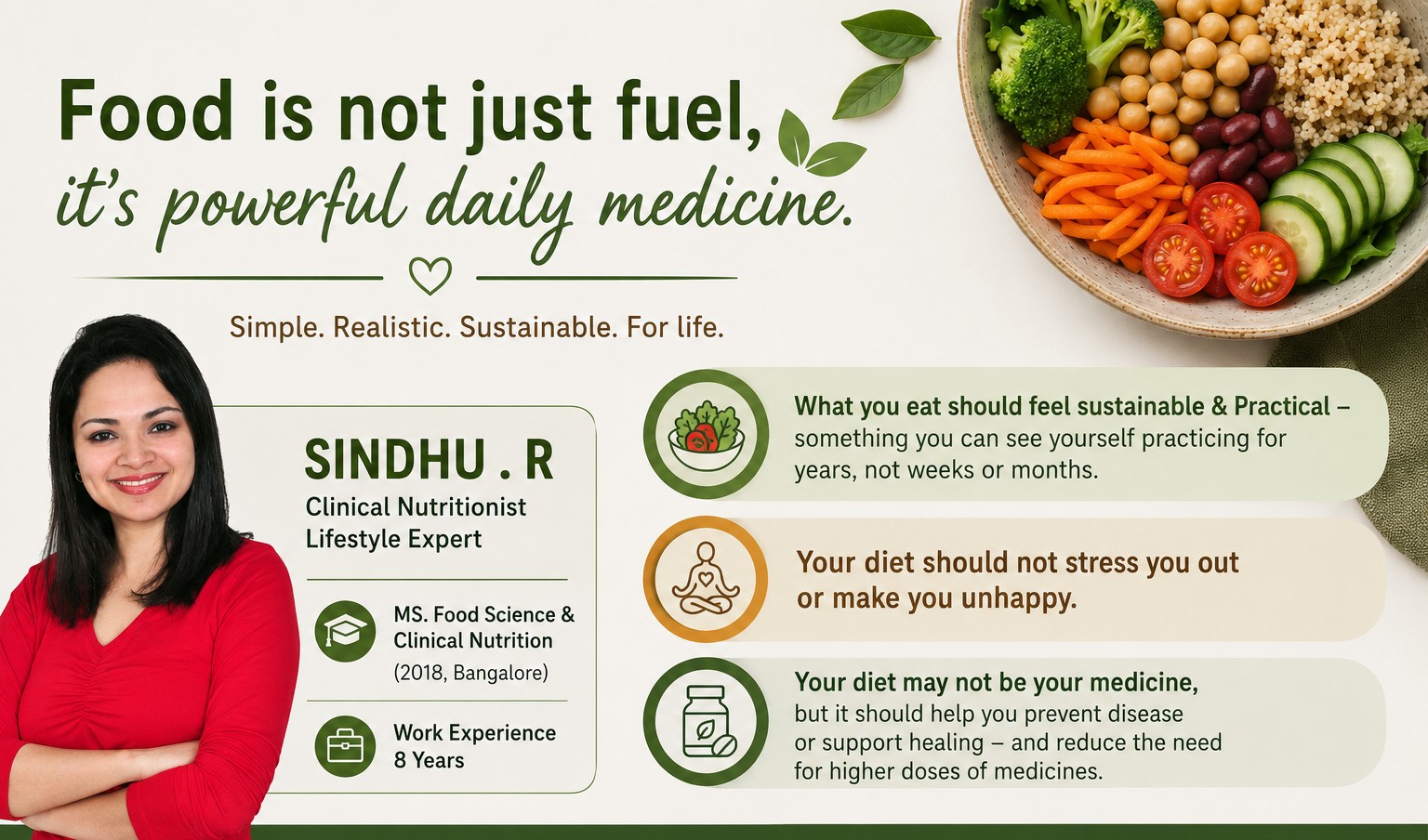
Food is not just fuel, it's powerful daily medicine. Simple. Realistic. Sustainable. For life. SINDHU . R - Clinical Nutritionist, Lifestyle Expert. MS. Food Science & Clinical Nutrition (2018, Bangalore). Work Experience 8 Years. What you eat should feel sustainable & Practical - something you can see yourself practicing for years, not weeks or months. Your diet should not stress you out or make you unhappy. Your diet may not be your medicine, but it should help you prevent disease or support healing - and reduce the need for higher doses of medicines.
THE PROTEIN STORY - title card, with bowls of soya beans, a salmon fillet, cottage cheese, mixed nuts, eggs and green peas on cream.

The basics

What protein does for you
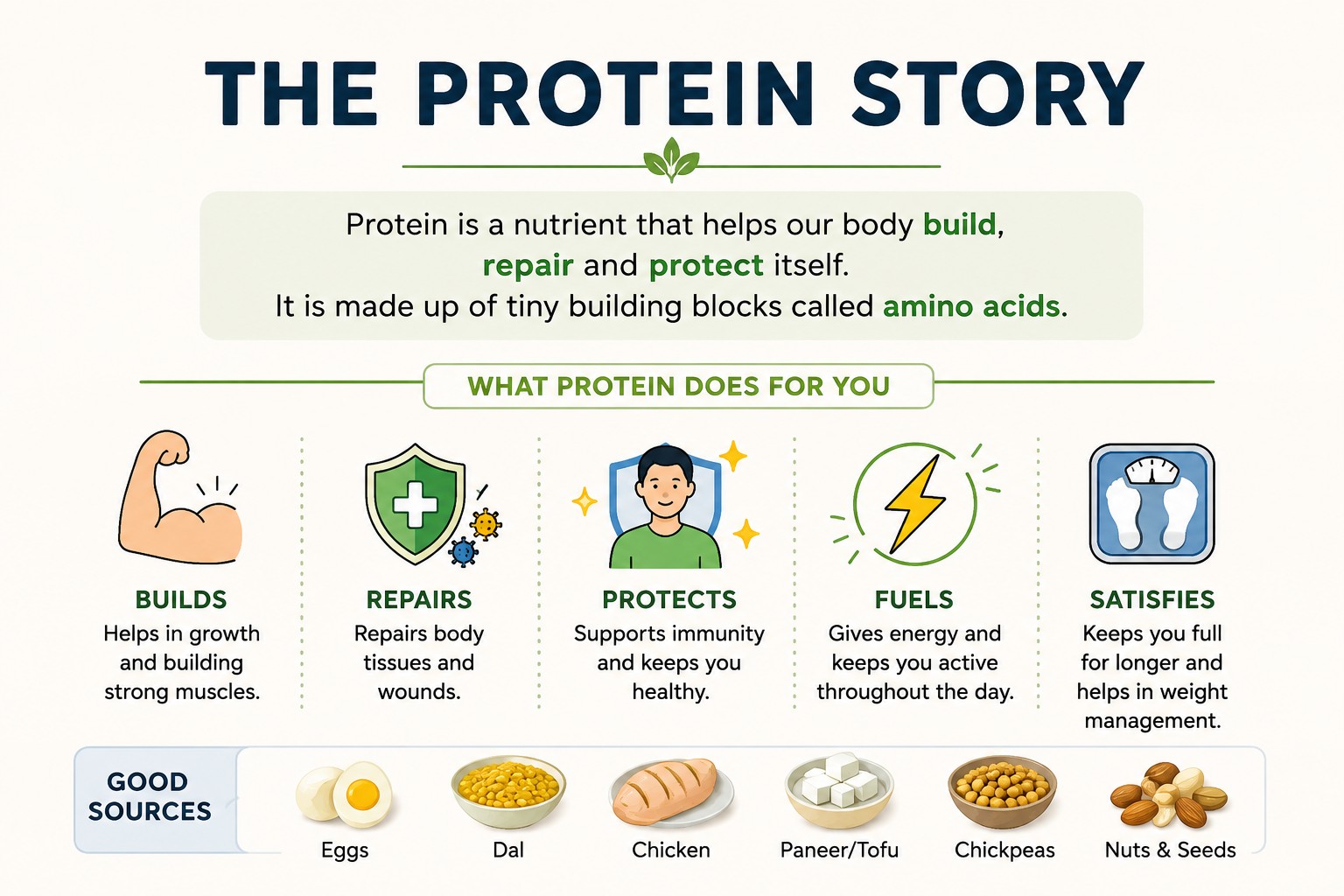
THE PROTEIN STORY. Protein is a nutrient that helps our body build, repair and protect itself. It is made up of tiny building blocks called amino acids. WHAT PROTEIN DOES FOR YOU - BUILDS: Helps in growth and building strong muscles. REPAIRS: Repairs body tissues and wounds. PROTECTS: Supports immunity and keeps you healthy. FUELS: Gives energy and keeps you active throughout the day. SATISFIES: Keeps you full for longer and helps in weight management. GOOD SOURCES: Eggs, Dal, Chicken, Paneer/Tofu, Chickpeas, Nuts & Seeds.

Context

Why Is There So Much Confusion About Protein Needs?


1. Social Media Hype

Protein has become one of the most talked-about nutrients on social media. While this has increased awareness, it has also led to exaggerated claims, making many people believe that "more protein is always better."

2. Fitness Industry Influence

Many gyms and fitness influencers promote very high protein intakes, often to support muscle-building goals. However, these recommendations are not suitable for everyone, as protein needs vary based on age, health, activity level, and individual goals.

3. Misinformation from Friends & Family

It's common to hear advice like, "I eat this much protein, so you should too." In reality, there is no one-size-fits-all recommendation—each person's protein requirement depends on their body, lifestyle, and medical condition.

4. The Rise of 'Protein-Fortified' Foods

Today, protein is being added to everything from biscuits and chips to ice creams and chocolates. Clever marketing can create the impression that everyone needs extra protein, even when their regular diet may already be meeting their needs. The overall quality of the food matters just as much as its protein content.

Key Takeaway : Protein is essential—but the right amount depends on you, not on trends, marketing, or someone else's diet.

How much

The truth — ICMR & doctor recommendations
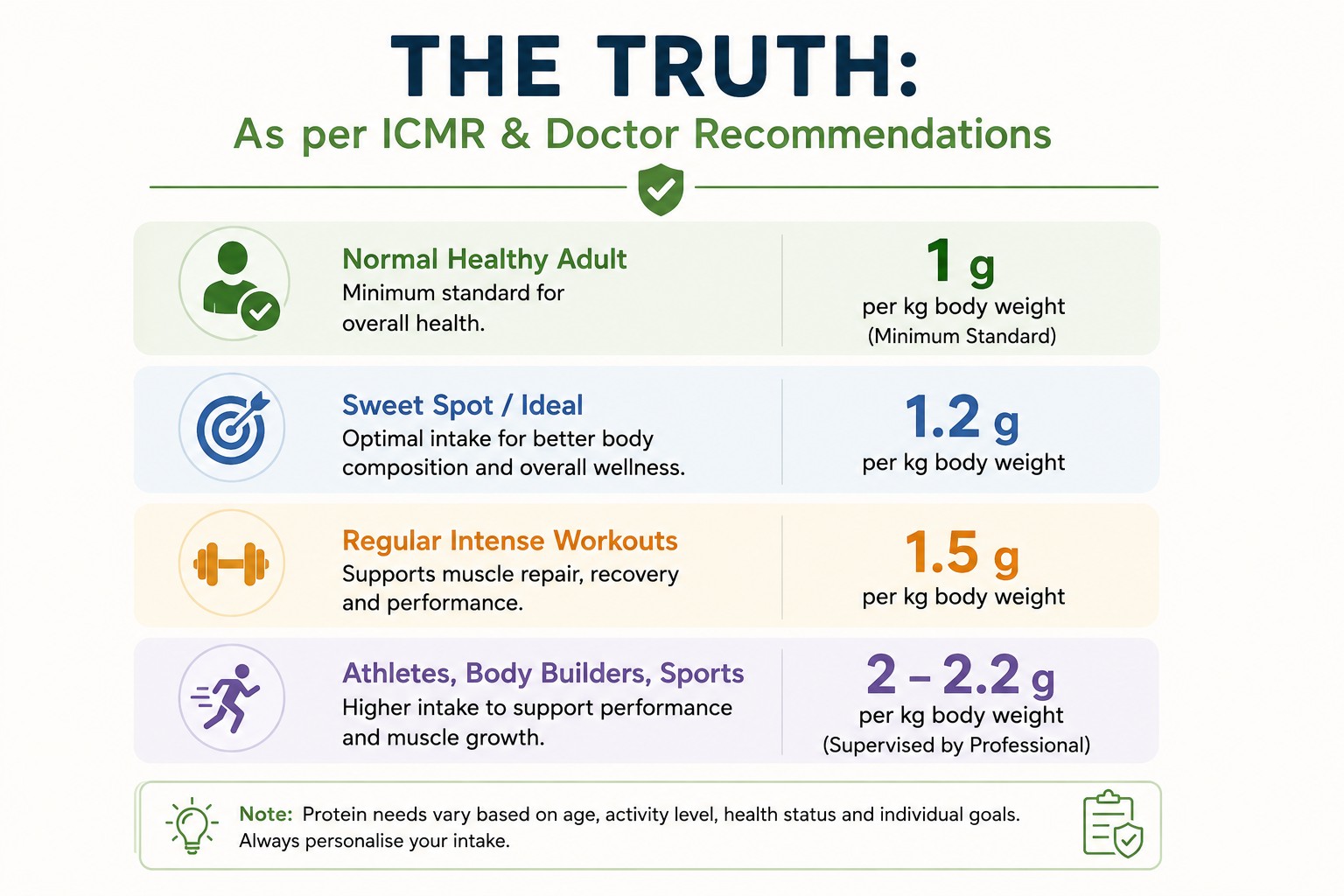
THE TRUTH: As per ICMR & Doctor Recommendations. Normal Healthy Adult - minimum standard for overall health - 1 g per kg body weight (Minimum Standard). Sweet Spot / Ideal - optimal intake for better body composition and overall wellness - 1.2 g per kg body weight. Regular Intense Workouts - supports muscle repair, recovery and performance - 1.5 g per kg body weight. Athletes, Body Builders, Sports - higher intake to support performance and muscle growth - 2 to 2.2 g per kg body weight (Supervised by Professional). Note: Protein needs vary based on age, activity level, health status and individual goals. Always personalise your intake.

Let's discuss

Is it only the quantity of protein that matters ?


  • If yes - why?
  • If no - how?
  • what else do you think matters ?
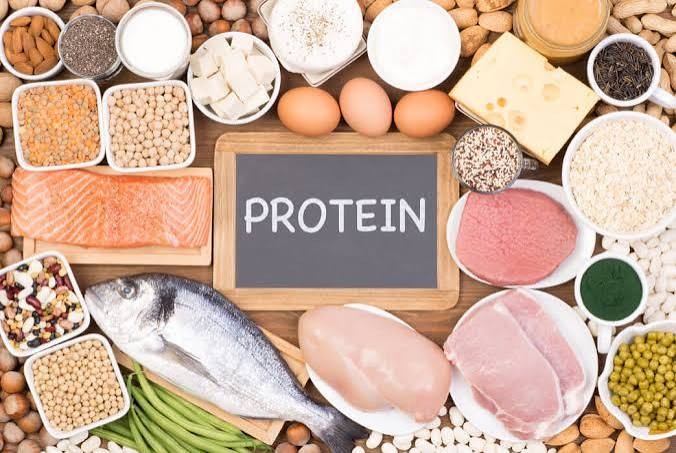
Flat-lay of protein-rich foods around a chalkboard reading PROTEIN: salmon, fish, chicken, meat, eggs, cheese, milk, tofu, yoghurt, lentils, chickpeas, soya beans, oats, nuts and seeds.

Building blocks

What are proteins made of?
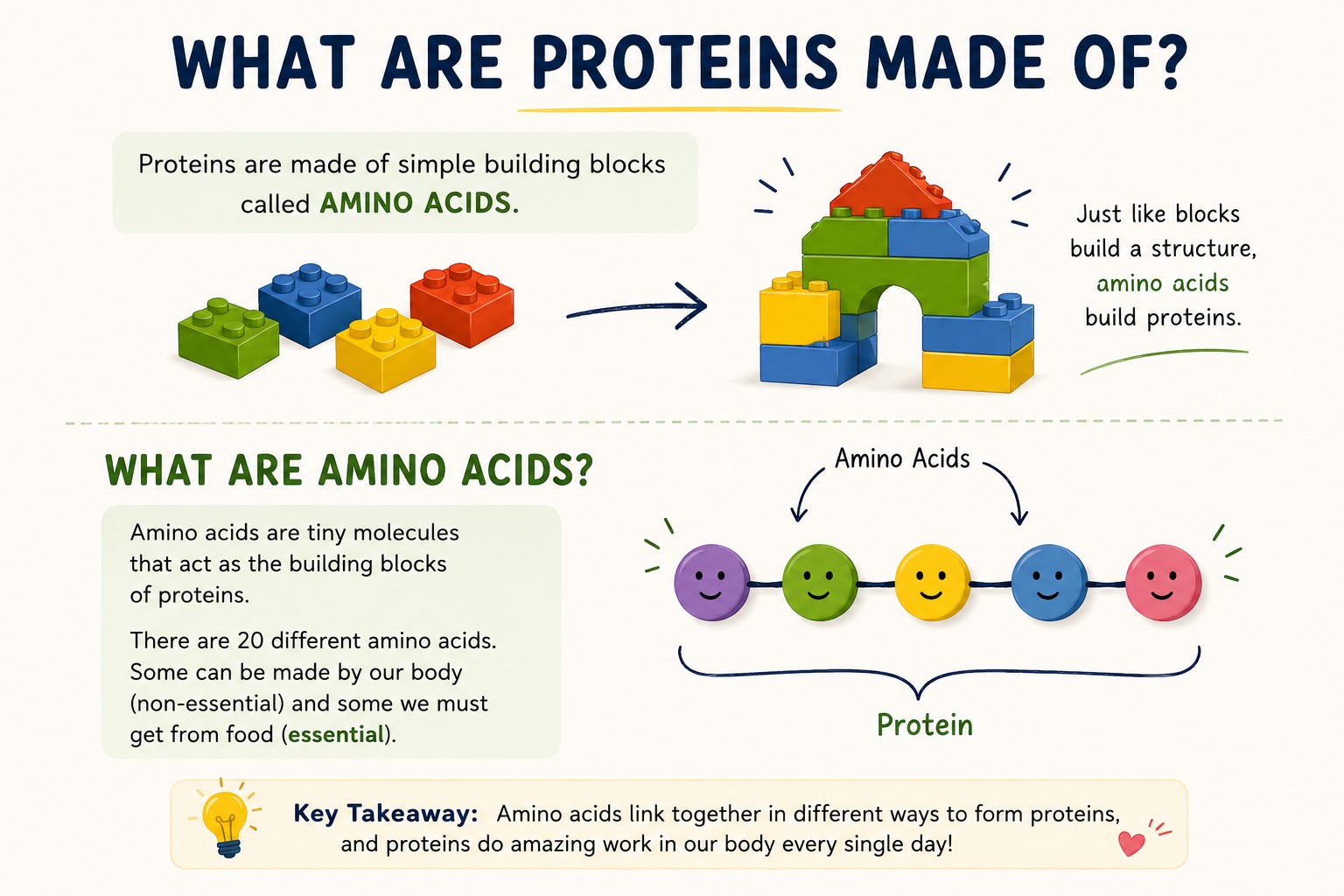
WHAT ARE PROTEINS MADE OF? Proteins are made of simple building blocks called AMINO ACIDS. Just like blocks build a structure, amino acids build proteins. WHAT ARE AMINO ACIDS? Amino acids are tiny molecules that act as the building blocks of proteins. There are 20 different amino acids. Some can be made by our body (non-essential) and some we must get from food (essential). Key Takeaway: Amino acids link together in different ways to form proteins, and proteins do amazing work in our body every single day!

Quality

Quality of protein matters

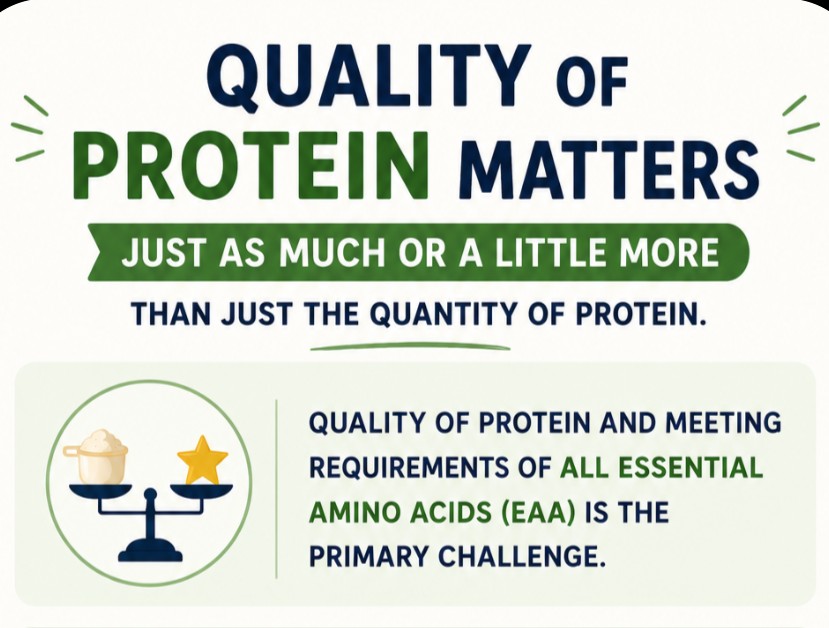
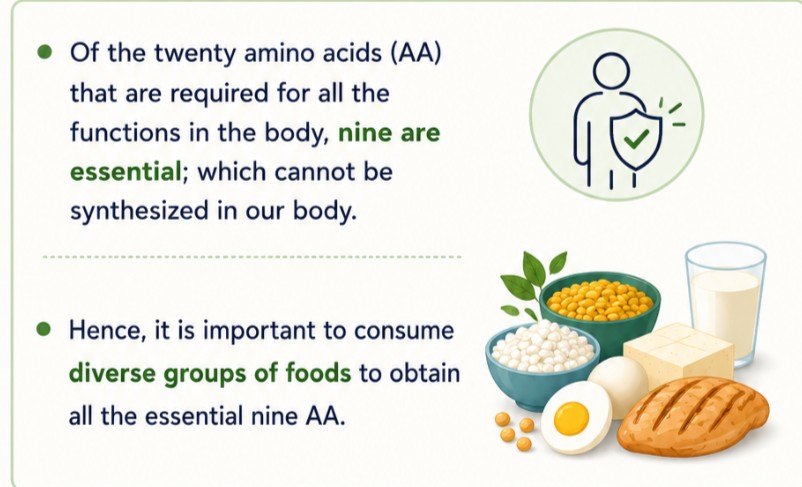
QUALITY OF PROTEIN MATTERS - JUST AS MUCH OR A LITTLE MORE THAN JUST THE QUANTITY OF PROTEIN. Quality of protein and meeting requirements of ALL ESSENTIAL AMINO ACIDS (EAA) is the primary challenge. Of the twenty amino acids (AA) that are required for all the functions in the body, nine are essential; which cannot be synthesized in our body. Hence, it is important to consume diverse groups of foods to obtain all the essential nine AA.

Vegetarian diet

Smart choices, not just more protein
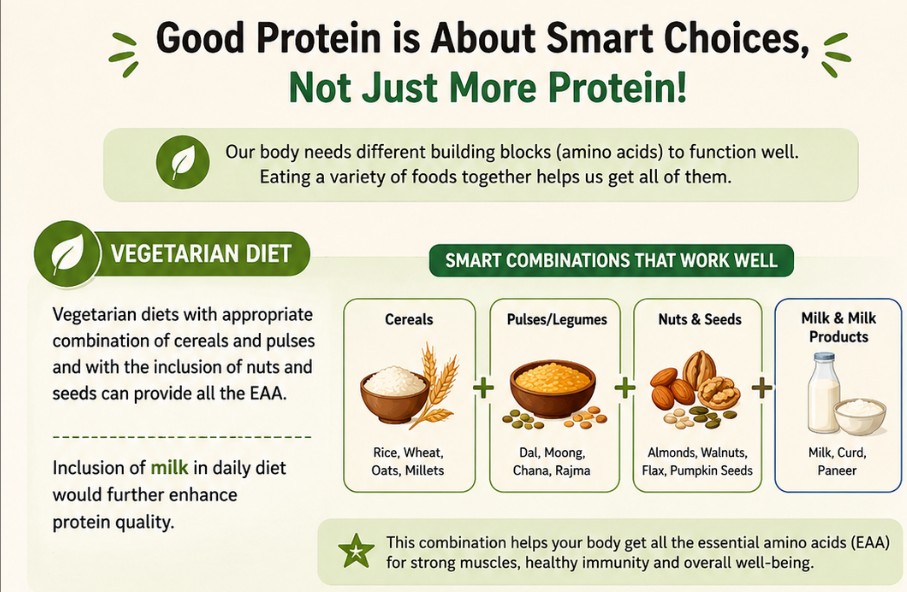
Good Protein is About Smart Choices, Not Just More Protein! Our body needs different building blocks (amino acids) to function well. Eating a variety of foods together helps us get all of them. VEGETARIAN DIET: Vegetarian diets with appropriate combination of cereals and pulses and with the inclusion of nuts and seeds can provide all the EAA. Inclusion of milk in daily diet would further enhance protein quality. SMART COMBINATIONS THAT WORK WELL: Cereals (Rice, Wheat, Oats, Millets) + Pulses/Legumes (Dal, Moong, Chana, Rajma) + Nuts & Seeds (Almonds, Walnuts, Flax, Pumpkin Seeds) + Milk & Milk Products (Milk, Curd, Paneer). This combination helps your body get all the essential amino acids (EAA) for strong muscles, healthy immunity and overall well-being.

Non-vegetarian diet

Balanced plate for quality protein
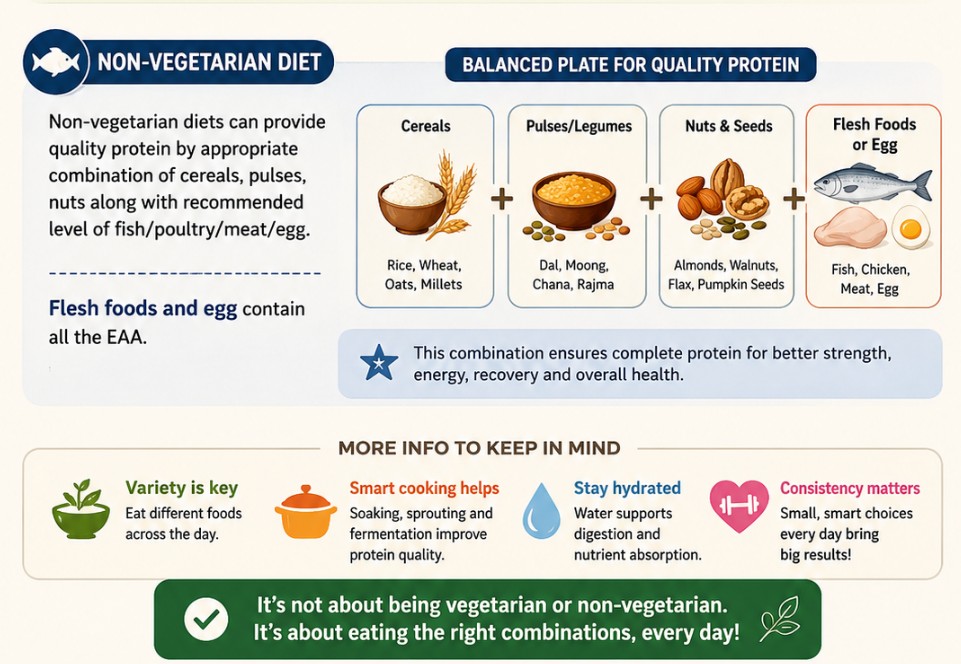
NON-VEGETARIAN DIET: Non-vegetarian diets can provide quality protein by appropriate combination of cereals, pulses, nuts along with recommended level of fish/poultry/meat/egg. Flesh foods and egg contain all the EAA. BALANCED PLATE FOR QUALITY PROTEIN: Cereals (Rice, Wheat, Oats, Millets) + Pulses/Legumes (Dal, Moong, Chana, Rajma) + Nuts & Seeds (Almonds, Walnuts, Flax, Pumpkin Seeds) + Flesh Foods or Egg (Fish, Chicken, Meat, Egg). This combination ensures complete protein for better strength, energy, recovery and overall health. MORE INFO TO KEEP IN MIND - Variety is key: Eat different foods across the day. Smart cooking helps: Soaking, sprouting and fermentation improve protein quality. Stay hydrated: Water supports digestion and nutrient absorption. Consistency matters: Small, smart choices every day bring big results! It's not about being vegetarian or non-vegetarian. It's about eating the right combinations, every day!

Sources

Both animal and plant foods

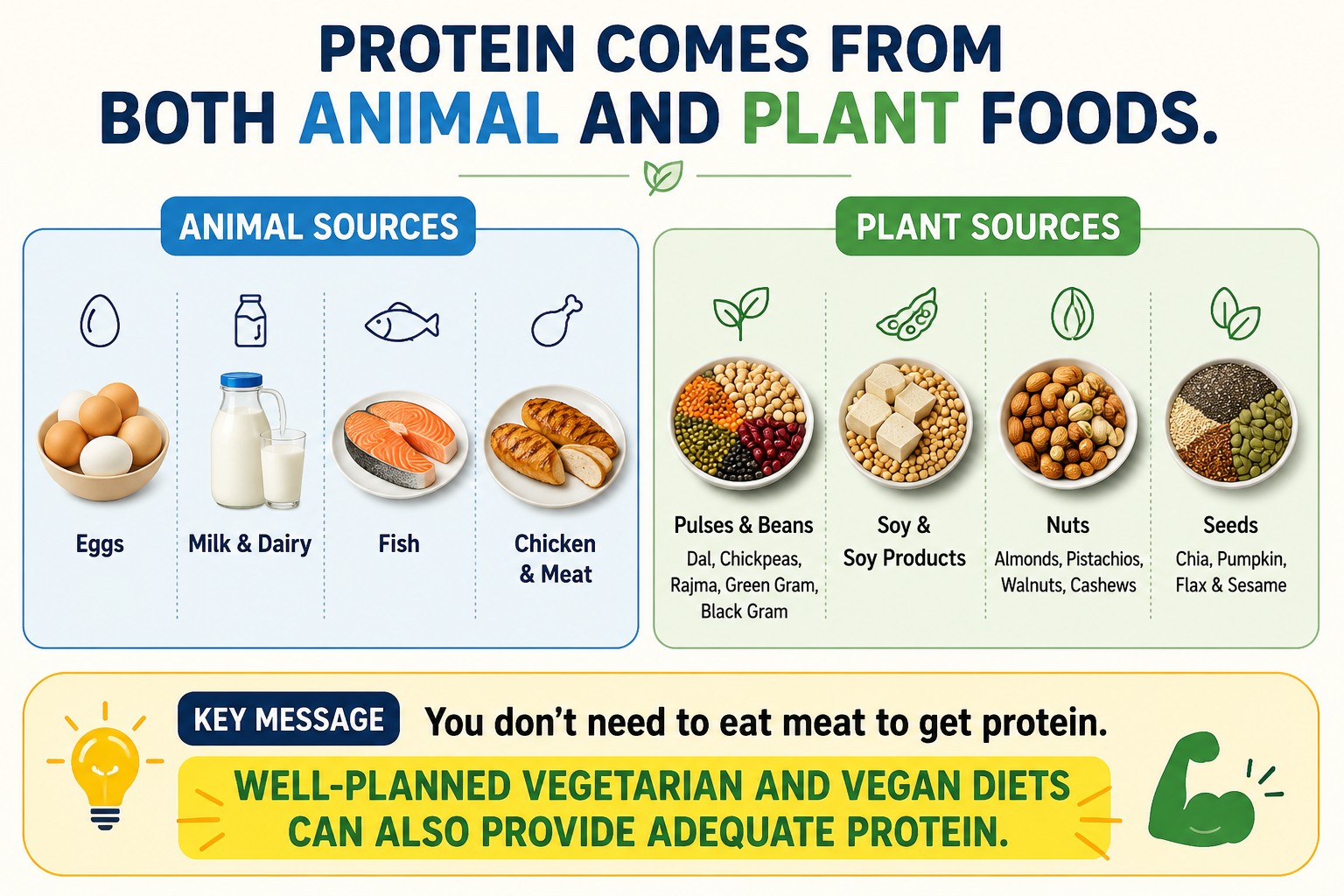
PROTEIN COMES FROM BOTH ANIMAL AND PLANT FOODS. ANIMAL SOURCES: Eggs; Milk & Dairy; Fish; Chicken & Meat. PLANT SOURCES: Pulses & Beans (Dal, Chickpeas, Rajma, Green Gram, Black Gram); Soy & Soy Products; Nuts (Almonds, Pistachios, Walnuts, Cashews); Seeds (Chia, Pumpkin, Flax & Sesame). KEY MESSAGE: You don't need to eat meat to get protein. WELL-PLANNED VEGETARIAN AND VEGAN DIETS CAN ALSO PROVIDE ADEQUATE PROTEIN.

Protein quality

Not All Proteins Are Same..


Animal foods such as eggs, milk, fish and meat generally provide all 9 EAAs in good amounts.

Many plant proteins may have lower amounts of one or more EAAs.

So, what should vegetarians do?

Combine different plant foods!
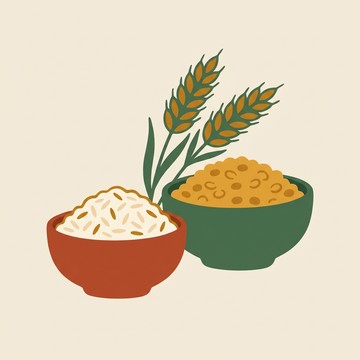
Cereals + Pulses

Rice + Dal  |  Roti + Dal  |  Khichdi

This combination helps improve the overall amino acid quality of the meal.

Key message: Variety is the secret to getting good-quality protein from plant foods.

Powerhouse — and a reality check

Why pulses are a protein powerhouse
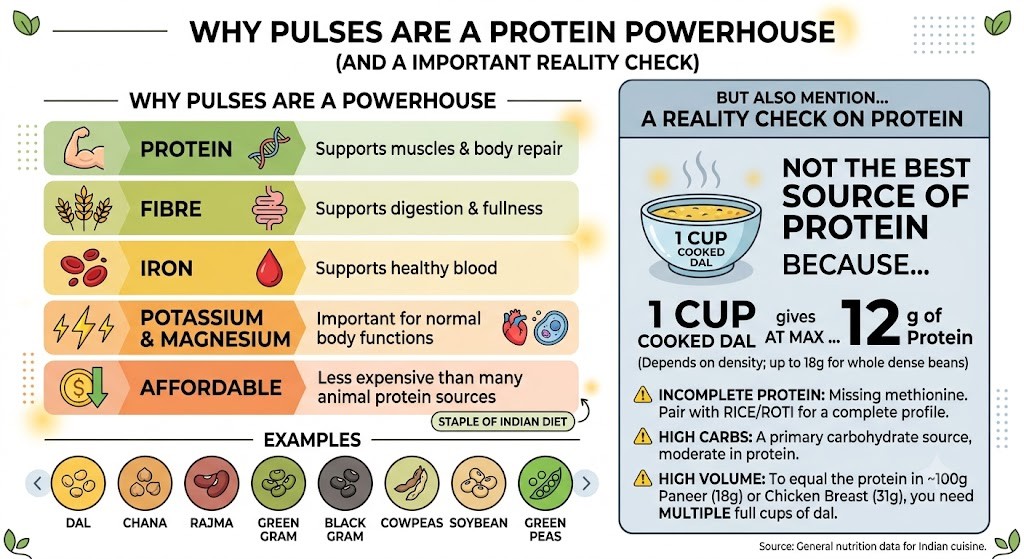
WHY PULSES ARE A PROTEIN POWERHOUSE (AND A IMPORTANT REALITY CHECK). WHY PULSES ARE A POWERHOUSE: PROTEIN - Supports muscles & body repair. FIBRE - Supports digestion & fullness. IRON - Supports healthy blood. POTASSIUM & MAGNESIUM - Important for normal body functions. AFFORDABLE - Less expensive than many animal protein sources. STAPLE OF INDIAN DIET. EXAMPLES: Dal, Chana, Rajma, Green Gram, Black Gram, Cowpeas, Soybean, Green Peas. BUT ALSO MENTION - A REALITY CHECK ON PROTEIN: 1 cup cooked dal is NOT THE BEST SOURCE OF PROTEIN BECAUSE... 1 CUP COOKED DAL gives AT MAX 12 g of Protein (Depends on density; up to 18g for whole dense beans). INCOMPLETE PROTEIN: Missing methionine. Pair with RICE/ROTI for a complete profile. HIGH CARBS: A primary carbohydrate source, moderate in protein. HIGH VOLUME: To equal the protein in ~100g Paneer (18g) or Chicken Breast (31g), you need MULTIPLE full cups of dal. Source: General nutrition data for Indian cuisine.

Let's think

Will protein consumption alone help build muscles?

Protein alone ≠ muscle. Protein needs support!
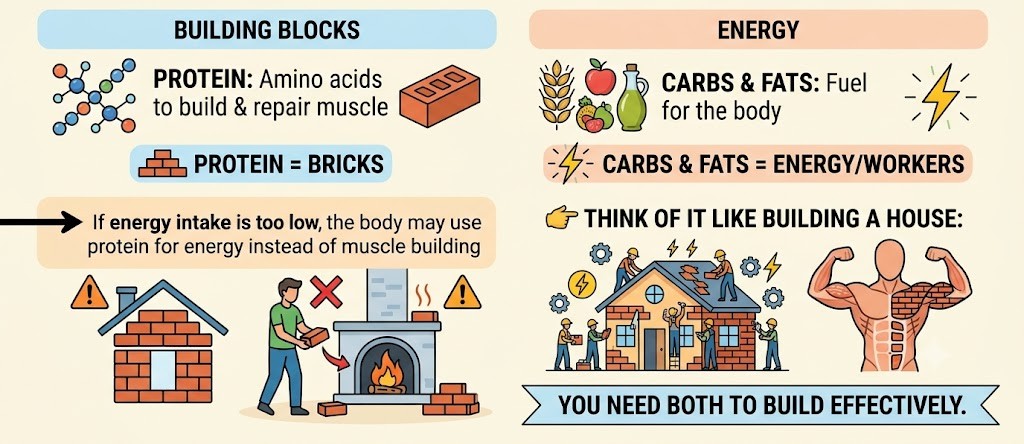
PROTEIN NEEDS SUPPORT! BUILDING BLOCKS - PROTEIN: Amino acids to build & repair muscle. PROTEIN = BRICKS. If energy intake is too low, the body may use protein for energy instead of muscle building. ENERGY - CARBS & FATS: Fuel for the body. CARBS & FATS = ENERGY/WORKERS. THINK OF IT LIKE BUILDING A HOUSE: YOU NEED BOTH TO BUILD EFFECTIVELY.

Muscle

Exercise Tells Your Body to Build Muscle

Protein + Energy + Strength Training = Muscle Growth

1

Eat enough protein

→ Provides the raw material for muscle repair & growth

2

Get enough energy

→ Carbohydrates & healthy fats help spare protein for its main job

3

Do strength exercises

→ Gives your muscles the signal to grow and become stronger

4

Stay physically active

→ Without regular activity, muscle loss/atrophy can occur

The takeaway: Protein alone won't build muscle.

NeeyaFit member add-on

Your own 1:1 diet plan — built around your training


  • Today's guidance is general. A 1:1 plan makes it yours — mapped to your training days, your goals, your body.
  • Your body changes as you train — so your plan does too, rebuilt for you every month, never a one-time PDF.
  • You're not left to figure it out alone — reach her through the week with questions, not just a document you open once.

This is a relationship, not a download — a real conversation to understand you, a plan built only for you, and someone in your corner through the week.

Ask Sindhu for the full pricing — the diet plan on its own, or bundled with your training.