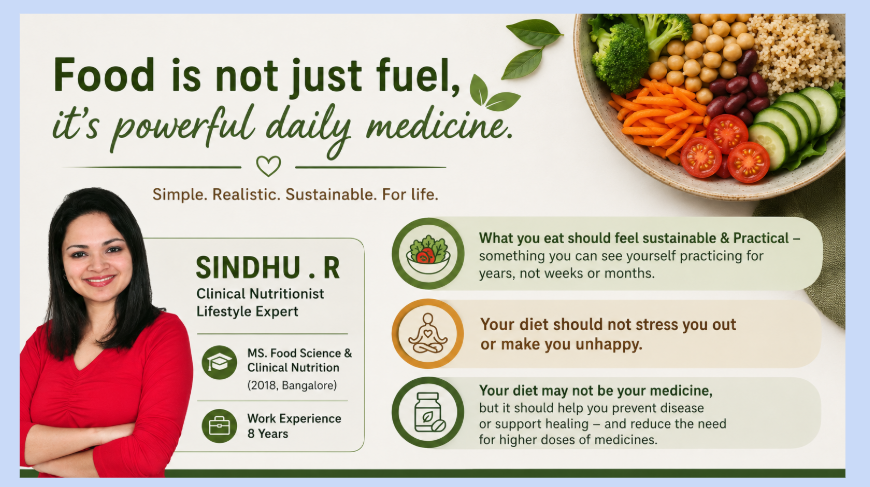
Knowledge-sharing session
Small Nutrients,Big Jobs
The role of vitamins & minerals in everyday health — and how to eat them smarter
Sindhu R · Clinical Nutritionist
Why it matters · The basics
Hidden hunger: a full plate, missing nutrients
of Indian women (15–49 y) are anaemic
NFHS-5, 2019–21
of Indian children (6–59 months) are anaemic
NFHS-5, 2019–21
of Indians in many studies have low vitamin D — in a sunny country
Aparna et al., 2018
Meet Priya, 32
IT professional · vegetarian
Eats three meals a day — yet always tired, losing hair, catching every cold and craving sugar by 4 pm.
Her reports
Enough calories — not enough micronutrients.
Fuel vs spark plugs
Macros = the fuel
Carbs, protein & fat give calories and building blocks.
Micros = the spark plugs
Vitamins & minerals give 0 kcal — but switch on the reactions that release energy.
Tiny amounts, big jobs
A day's B12 need is 2.5 µg — lighter than a grain of salt.
Mostly not made by us
Except vitamin D (sun), K & biotin (gut bacteria), niacin (from protein).
Sources: NFHS-5, MoHFW 2021; Aparna P et al., J Family Med Prim Care 2018; Stevens GA et al., Lancet Glob Health 2022; ICMR-NIN Nutrient Requirements 2020
The micronutrient family
Meet the family — and the kitchen rules
Fat-soluble
Vitamins · stored in the body
Need some fat in the meal to be absorbed. Stored in liver & fat — excess can build up (almost always from supplements).
Water-soluble
Vitamins · need regular top-ups
8 B-vitamins + vitamin C. Little storage (except B12). Easily lost into cooking water, heat, air & light.
Macro-minerals
Minerals · need > 100 mg a day
Calcium, magnesium, potassium, sodium, phosphorus — bones, fluids, nerves & muscles.
Trace minerals
Minerals · need < 100 mg a day
Iron, zinc, iodine, selenium, copper — tiny doses, big roles in blood, immunity & thyroid.
Vitamin-saving kitchen rules
Wash vegetables before cutting, not after
Cut in big pieces, just before cooking
Steam or pressure-cook; reuse the water in dal, soup or atta
No baking soda in dal or greens — it destroys B1 & C
Add lemon after cooking — and eat some veggies raw
Sources: ICMR-NIN Dietary Guidelines for Indians 2024; ICMR-NIN 2020; Krause's Food & the Nutrition Care Process, 16th ed.
Vitamins at a glance
What each vitamin does — and where to find it
| Vitamin | Main job | Find it in | Low levels may show as |
|---|---|---|---|
| A | Night vision, immunity, skin & gut lining | Carrot, pumpkin, papaya, mango, drumstick leaves, egg yolk | Night blindness, dry eyes & skin, infections |
| D | Absorbs calcium; bones, muscles, immunity | Midday sun, egg yolk, fatty fish, fortified milk/oil | Bone & back pain, muscle weakness, fatigue |
| E | Antioxidant; guards cell membranes | Almonds, sunflower seeds, peanuts, vegetable oils | Rare: nerve & muscle problems |
| K | Blood clotting; locks calcium into bone | Leafy greens, broccoli; fermented foods, cheese, eggs | Easy bruising, bleeding gums |
| C | Immunity, collagen, boosts iron absorption | Amla, guava, lemon, orange, capsicum, sprouts — some raw | Bleeding gums, slow healing, frequent colds |
| B-complex | Turns food into energy; nerves, blood & DNA | Whole grains, dals, milk, curd, eggs, nuts, greens | Fatigue, mouth ulcers, tingling, anaemia, brain fog |
Spotlight: vitamin D
The sunshine paradox
Why so many sun-rich Indians are low: indoor lives, covered skin, pollution & window glass, darker skin, ageing, few food sources.
The smart-sun habit
- ✓ 15–30 min, arms & legs uncovered
- ✓ Around 10 am–3 pm: shadow shorter than you
- ✓ A few days a week; never burn
of dietary calcium absorbed when vitamin D is low vs sufficient — milk alone isn't enough.
Sources: ICMR-NIN 2020; NIH Office of Dietary Supplements fact sheets; Holick MF, NEJM 2007; Aparna P et al., 2018; Krause's 16th ed.
Spotlight
B12 & folate: the blood-and-nerve duo
Who runs low on B12?
Vegetarians & vegans — B12 comes almost only from animal foods
Adults over 50 — less stomach acid to release B12 from food
Long-term metformin or antacids (PPIs) — reduce absorption
Gut conditions, gastric or bariatric surgery — less intrinsic factor
Heavy alcohol use — poorer intake & absorption
Illustrative case: Anil, 58
Type 2 diabetes, on metformin for 8 years
Burning, tingling feet — assumed to be diabetic nerve damage. His B12 was 150 pg/mL. Lesson: anyone on long-term metformin should have B12 checked periodically (ADA Standards of Care).
Folate: protecting new life
- Folic acid before conception and in early pregnancy cuts neural-tube defect risk by up to ~70% (MRC Vitamin Study, 1991)
- Find it in: green leafy veg, chana, rajma, oranges, fortified atta
- Caution: high-dose folic acid can hide B12-deficiency anaemia while nerve damage progresses — test both
Sources: ADA Standards of Care in Diabetes 2025; MRC Vitamin Study Research Group, Lancet 1991; ICMR-NIN 2020
Macro-minerals
The structure-and-signal minerals
Calcium
builder of bones, messenger for muscles
Does: 99% sits in bones & teeth; also muscle contraction, heartbeat, nerve signals, clotting
Find it in: milk, curd, paneer, ragi, til (sesame), rajgira, tofu
Low levels: weak bones (osteoporosis), cramps
Daily need (adults): 1,000 mg
Magnesium
the relaxer, in 300+ reactions
Does: energy production, muscle & nerve relaxation, sleep, blood-sugar control, activating vitamin D
Find it in: pumpkin seeds, almonds, cashews, whole grains, leafy greens
Low levels: cramps, eye twitches, anxiety, palpitations
Daily need (adults): men 440 mg, women 370 mg
Potassium
sodium's counterweight
Does: fluid balance, nerve signals, muscle & heart rhythm; helps lower blood pressure
Find it in: banana, coconut water, potato, tomato, orange, dals, greens
Low levels: weakness, cramps, higher BP
Daily need (adults): 3,510 mg
Sources: ICMR-NIN 2020; ICMR-NIN Dietary Guidelines for Indians 2024 (salt < 5 g/day); WHO potassium guideline 2012
Spotlight
Iron: the oxygen courier
What iron does
Builds haemoglobin, which carries oxygen from your lungs to every cell — plus energy, immunity & brain development.
Signs of low iron
- Tired & breathless on stairs
- Pale skin, nails & inner eyelids
- Hair fall; brittle or spoon-shaped nails
- Poor focus; cold hands & feet
- Craving ice, chalk or clay (pica)
Not all iron is equal
Heme iron
meat, fish, poultry
15–35% absorbedNon-heme iron
dals, greens, ragi, bajra, poha, dates, jaggery, garden-cress (halim) seeds
2–20% absorbedMost Indian diets rely on non-heme (plant) iron — so what you pair it with decides how much you actually absorb. More on that in a moment!
Illustrative case
Sneha, 19
Vegetarian college student. Skips breakfast, drinks 3–4 cups of chai a day. Always tired, breathless on stairs, hair fall.
Higher-risk groups
Menstruating & pregnant women, infants & teens, vegetarians, endurance athletes, frequent blood donors
Sources: NIH Office of Dietary Supplements, Iron fact sheet; NFHS-5; Krause's 16th ed.
Zinc · Iodine · Selenium
Trace minerals: tiny amounts, huge impact
Zinc
What it does
Immunity, wound healing, taste & smell, skin, hair, growth & fertility
Find it in
Pumpkin & sesame seeds, chickpeas, cashews, whole grains, dairy, eggs, meat, shellfish
Real life
Zinc with ORS for 10–14 days shortens childhood diarrhoea (WHO/UNICEF). Over 40 mg/day long-term can cause copper deficiency.
Iodine
What it does
Makes thyroid hormones that set your metabolism and build a baby's brain
Find it in
Iodised salt, seafood, milk, curd, eggs
Real life
World's leading preventable cause of brain damage (WHO). Pink & rock salts are usually NOT iodised; keep salt in a closed jar.
Selenium
What it does
Antioxidant enzymes; converts thyroid hormone T4 into active T3; immunity
Find it in
Brazil nuts, eggs, fish, mushrooms, sunflower seeds, whole grains
Real life
1–2 Brazil nuts can meet a day's need. More isn't better: excess causes hair & nail loss.
Sources: WHO/UNICEF joint statement on zinc for diarrhoea 2004; WHO iodine deficiency reports; ICMR-NIN 2020
Better together
Nutrients work as a team
What you eat ≠ what you absorb
Bioavailability — the share of a nutrient your body actually absorbs and uses — depends on:
- Partners that boost it
- Blockers that compete or bind
- How food is cooked & processed
- Your gut health, age & medicines
Sources: Krause's 16th ed.; Hurrell R & Egli I, Am J Clin Nutr 2010; Uwitonze AM & Razzaque MS, J Am Osteopath Assoc 2018
Power couple #1
Iron + vitamin C: squeeze the lemon!
Vitamin C converts plant iron into a form the gut can absorb and keeps it soluble. Adding vitamin C-rich food to a meal can raise non-heme iron absorption 2–3 times.
Palak dal + a squeeze of lemon
Iron: moong/toor dal + spinach
Vit C: fresh lemon, added after cooking
Lemon poha with peanuts & peas
Iron: poha, peanuts
Vit C: lemon, green peas, coriander
Rajma or chole + kachumber
Iron: kidney beans / chickpeas
Vit C: tomato, onion, lemon, raw mango
Sprouted moong chaat
Iron: sprouts (sprouting also cuts phytates)
Vit C: tomato, lemon, raw mango
Bajra or ragi roti + amla chutney
Iron: millets
Vit C: amla — or a guava after the meal
Til-gur laddoo or dates + an orange
Iron: sesame, jaggery, dates
Vit C: orange or guava — not chai!
Sources: Hallberg L et al., Am J Clin Nutr 1989; Lynch SR & Cook JD, Ann NY Acad Sci 1980; ICMR-NIN DGI 2024
Power couple #2
Vitamins A, D, E & K + a little healthy fat
Why the fat?
These vitamins (and carotenoids) hitch a ride into the body inside tiny fat 'bubbles' called micelles. No fat → much of it passes straight through.
3–5 gof fat in a meal — about 1 tsp — is enough to markedly boost carotenoid absorption
Carrot juice + 1 tsp ground flaxseed
Beta-carotene + omega-3 fat. Use ground flax or soaked chia — whole seeds pass undigested.
Sarson saag or palak with 1 tsp ghee
Vitamins A & K from greens, absorbed better thanks to the tadka. Grandma was right!
Salad + peanuts, til or an egg
Oil dressing, roasted seeds or an egg lift carotenoid & vitamin E uptake (Kim et al., 2015).
Pumpkin or sweet potato roasted in oil
Orange veggies are beta-carotene treasure chests — cooking with a little fat unlocks more.
Mango or papaya + a few almonds
Vitamin A from the fruit, vitamin E & fat from the nuts — a perfect evening snack.
Vitamin D3 with your biggest meal
Taken with the largest, fat-containing meal, D3 raised blood levels ~50% (Mulligan & Licata, 2010).
Sources: Brown MJ et al., AJCN 2004; Kim JE et al., AJCN 2015; Mulligan GB & Licata A, J Bone Miner Res 2010; Jayarajan P et al., IJMR 1980
More power couples
Partners that help each other work
Calcium + vitamin D (+ K2)
Vitamin D lets the gut absorb calcium; K2 helps steer it into bones rather than arteries.
Try: ragi malt with milk after a 20-min sunny walk; curd with til chutney
Vitamin D + magnesium
Magnesium is needed to activate vitamin D — when Mg is low, D supplements work less well.
Try: D3 with a meal of dal, greens & a handful of pumpkin seeds
Iron, zinc & calcium + soak, sprout, ferment
Phytates in grains & pulses lock up minerals; soaking, sprouting & fermenting break them down.
Try: idli, dosa, dhokla, sprouted moong, overnight-soaked chana, ragi ambli
Folate + vitamin B12
They work as a pair to build healthy red blood cells & DNA; low B12 'traps' folate in an unusable form.
Try: palak paneer, methi thepla with curd, egg bhurji with spinach
Sources: Holick MF, NEJM 2007; Uwitonze AM & Razzaque MS, 2018; Gibson RS et al., Food Nutr Bull 2010; Shoba G et al., Planta Med 1998
Absorption blockers
The 'frenemies' on your plate
Chai or coffee with meals
Tea tannins can cut the absorption of plant iron by up to 60–90%.
Fix: have tea/coffee at least 1 hour before or after meals
Calcium vs iron
They compete for absorption when taken together.
Fix: space calcium & iron tablets 2+ hours apart
Phytates
Found in bran, whole grains & pulses — they bind iron, zinc and calcium.
Fix: soak, sprout, ferment & cook grains and dals
Oxalates
Spinach calcium is only ~5% absorbed vs ~30% from milk.
Fix: count on dairy, ragi & til for calcium — not spinach
Some medicines
Antacids/PPIs lower B12, iron & Mg; metformin lowers B12; calcium & iron block thyroid tablets.
Fix: take thyroxine alone, 4 h from calcium/iron
Alcohol & smoking
Alcohol drains B1, folate, zinc & Mg; smokers need 35 mg more vitamin C a day.
Fix: limit alcohol; extra vitamin C foods if you smoke
Sources: Hurrell RF et al., Br J Nutr 1999; Weaver CM et al., AJCN 1999; ICMR-NIN DGI 2024; IOM DRIs for vitamin C (smokers +35 mg/day)
Supplementation
Food first — but not always food only
The ground rules
- Supplements fill gaps — they can't fix a poor diet
- Test, don't guess — check levels first
- More is not better — fat-soluble vitamins & minerals can build up to toxic levels
- Tell your doctor about every supplement you take
Useful tests
CBC, serum ferritin, vitamin B12, 25(OH) vitamin D, TSH — others as advised
Who may genuinely need one?
Pregnancy & planning it
Folic acid before conception; iron-folic acid, calcium & iodine in pregnancy (as per antenatal protocols)
Vegetarians & vegans
Vitamin B12 almost always; check iron, vitamin D and omega-3 (algal DHA)
Adults over 50
B12 (less stomach acid), vitamin D and calcium for bone health
Little sun exposure
Vitamin D3 — dose guided by a blood test
Heavy periods or anaemia
Iron (with vitamin C), after confirming low Hb / ferritin
Medical conditions & medicines
Metformin, PPIs, IBD / celiac, bariatric surgery, kidney disease — need tailored plans
Sources: Anemia Mukt Bharat operational guidelines, MoHFW 2018; ICMR-NIN 2020; Krause's 16th ed.
Supplementation
Using supplements smartly: form, timing, safety
| Nutrient | Smarter form | When to take | Watch out for |
|---|---|---|---|
| Vitamin D | D3 (cholecalciferol) raises blood levels better than D2 | With your largest, fat-containing meal | Adult upper limit 4,000 IU/day unless prescribed; excess → high calcium, kidney stones |
| Iron | Ferrous salts or bisglycinate (gentler); alternate-day dosing may absorb better | Empty stomach with lemon/orange; a small snack if it causes nausea | Not with tea, milk, calcium or antacids; dark stools are normal; keep away from children |
| Calcium | Carbonate (take with food) or citrate (any time; better with low stomach acid) | ≤ 500 mg elemental per dose; split larger doses | 4 h away from thyroid tablets; excess → constipation, kidney stones |
| Vitamin B12 | Methylcobalamin or cyanocobalamin; injections if absorption is poor | Morning, with or without food | Very safe; check B12 before taking high-dose folic acid |
| Magnesium | Glycinate or citrate (gentle); oxide acts more as a laxative | Evening — may help sleep & cramps | Avoid or adjust in kidney disease; loose stools = too much |
| Vitamin A | Mostly as beta-carotene from food | With a meal that has some fat | Preformed vitamin A above 3,000 µg/day is harmful; avoid high doses in pregnancy |
Sources: IOM DRIs 2011 (vitamin D, vitamin A ULs); Stoffel NU et al., Lancet Haematol 2017; Tripkovic L et al., AJCN 2012; NIH ODS fact sheets
Putting it together
A micronutrient-smart day
Breakfast
Veg poha with peanuts + lemon, or eggs + whole-wheat toast + an orange
1 hour later
Your chai or coffee — away from the iron-rich meal
Mid-morning
15–20 min of sun on arms & legs + a guava or amla
Lunch
Rajma-rice + kachumber with lemon + a bowl of curd
Evening
Carrot-beet juice + 1 tsp ground flaxseed, or roasted chana + nuts
Dinner
Palak paneer in 1 tsp ghee + bajra/ragi roti (D3 here, if prescribed)
Thank you! Questions?
5 things to remember
Eat a rainbow — variety covers most needs
Pair smart: iron + vitamin C; A, D, E, K + a little fat
Keep blockers apart: tea, calcium & iron
Cook to conserve: less water, less heat, lemon last
Test, don't guess — supplement with expert guidance
Bonus · Antioxidants
Antioxidants: your body's rust-proofing
The cut-apple test
Slice an apple and it turns brown within minutes. That's oxidation — the same family of reactions that rusts iron.
Squeeze lemon on it and it stays fresh. Lemon's vitamin C is an antioxidant: it takes the hit so the apple doesn't.
Inside our cells, the 'sparks' are called free radicals — unstable molecules that can damage fats, proteins and DNA.
Try it: cut an apple in two, add lemon to one half — compare after 20 minutes.
Sources of free radicals
Simply living
breathing, digesting, exercising — normal and needed
Smoking
including second-hand smoke
Air pollution
traffic, smog, chulha smoke
Too much sun
UV rays on unprotected skin
Heavy alcohol
loads the liver with oxidants
Reused frying oil
repeatedly heated oil forms harmful by-products
Two lines of defence
1 Your built-in fire brigade
The body makes its own antioxidant enzymes — they need zinc, copper, manganese & selenium from food.
2 Help from your plate
Vitamins C & E, carotenoids (beta-carotene, lycopene, lutein) and polyphenols in fruit, veg, dals, nuts, tea, coffee & spices.
Not all free radicals are bad. Immune cells use them to kill germs. Trouble starts with an imbalance — oxidative stress.
Sources: Halliwell B & Gutteridge JMC, Free Radicals in Biology and Medicine, 5th ed.; Sies H, Redox Biol 2015; Krause's 16th ed.; FSSAI used-cooking-oil norms
Bonus · Antioxidants on your plate
Eat the rainbow — each colour, a different shield
Red
LycopeneTomato, watermelon, red capsicum, guava (pink)
Cook tomatoes with a little oil — more lycopene is absorbed than from raw.
Orange & yellow
Beta-caroteneCarrot, pumpkin, papaya, mango, sweet potato
Body makes vitamin A from it only as needed — safe from food.
Green
Lutein, vitamin C, folatePalak, methi, drumstick leaves, broccoli, peas
Lutein collects in the eye's retina and helps filter harsh blue light.
Purple & blue
AnthocyaninsJamun, black grapes, purple cabbage, brinjal, black rice
The colour sits in the skin — don't peel it away.
White & brown
Polyphenols, vitamin EGarlic, onion, nuts, seeds, whole grains, dals, tea, coffee, spices
A small handful of nuts/seeds a day covers much of your vitamin E.
Vitamin C stars
Vitamin CAmla, guava, lemon, orange, capsicum, kachumber
Heat & air destroy it — have something raw every day.
How much?
400 g + 100 gvegetables (incl. greens) + fruit a day — ICMR-NIN 'My Plate for the Day'
risk of early death in people eating ~800 g fruit & veg a day vs very little (95 studies)
Easy rule: 2+ colours on every plate, 5+ colours across the day. Variety beats any single 'superfood'.
Sources: ICMR-NIN 'My Plate for the Day', DGI 2024; WHO healthy diet fact sheet; Aune D et al., Int J Epidemiol 2017; AREDS2 Research Group, JAMA 2013; Unlu NZ et al., J Nutr 2005
Bonus · Food vs pills
Antioxidants work best on a plate, not in a pill
As high-dose pills
Beta-carotene pills raised lung cancer in smokers by 18% (ATBC) and 28% (CARET)
Vitamin E pills (400 IU/day) raised prostate cancer by 17% (SELECT)
78 trials, ~297,000 people: no longer life; beta-carotene & vitamin E slightly raised deaths (Cochrane)
Mega-dose C + E blunted the health gains from exercise (small trial)
As real food
~30% fewer heart attacks & strokes with a Mediterranean-style diet rich in nuts & olive oil (PREDIMED)
~1/3 lower risk of early death with plenty of fruit & vegetables (95 studies)
Why the difference? Food brings fibre, potassium & hundreds of compounds together, in safe doses
One exception: a specific eye formula for macular degeneration — only on a doctor's advice
Myth-busters
'ORAC score' on the label? A test-tube number — the US government withdrew its ORAC database in 2012.
'Detox' & 'antioxidant water'? Your liver and kidneys do the detox. No drink does it for them.
'Superfood' powders? No single food beats variety — and powders often lose the fibre.
Start tomorrow
2+ colours on every plate
A small handful of nuts or seeds daily
Cook tomatoes & greens with a little oil
Something raw & vitamin C-rich every day
Move daily, don't smoke — your body's own defences grow stronger
Supplements only if a test or doctor says so
Sources: ATBC, NEJM 1994; CARET, NEJM 1996; SELECT, JAMA 2011; Bjelakovic, Cochrane 2012; Ristow, PNAS 2009; PREDIMED, NEJM 2018; Aune, IJE 2017; USDA 2012